

MSCI AND THE MARKET CREDIBILITY CHALLENGE
On October 16, 2026, Indonesia’s JCI fell 11.6% in a single session, its steepest one-day decline in 28 years, after MSCI opened a consultation on moving the market out of the Emerging Markets category and into the Standalone Markets. What makes the shock notable is that MSCI’s reasoning has little to do with economic growth. The index provider argued instead that investors can no longer identify who actually holds the shares, or whether the prices on the screen reflect genuine supply and demand. Vietnam carries some of the same structural weaknesses.
The rigor behind MSCI’s market classification
On October 15, 2026, MSCI opened a consultation on reclassifying Indonesia from Emerging Markets to Standalone Markets, which would take it out of the regional and global indices that most passive capital follows. If the proposal were adopted, funds tracking the MSCI Emerging Markets Index would have to sell their entire Indonesian holdings. The JCI’s performance since the start of the year already shows how heavily MSCI’s warnings have weighed on the market, well before any final decision.
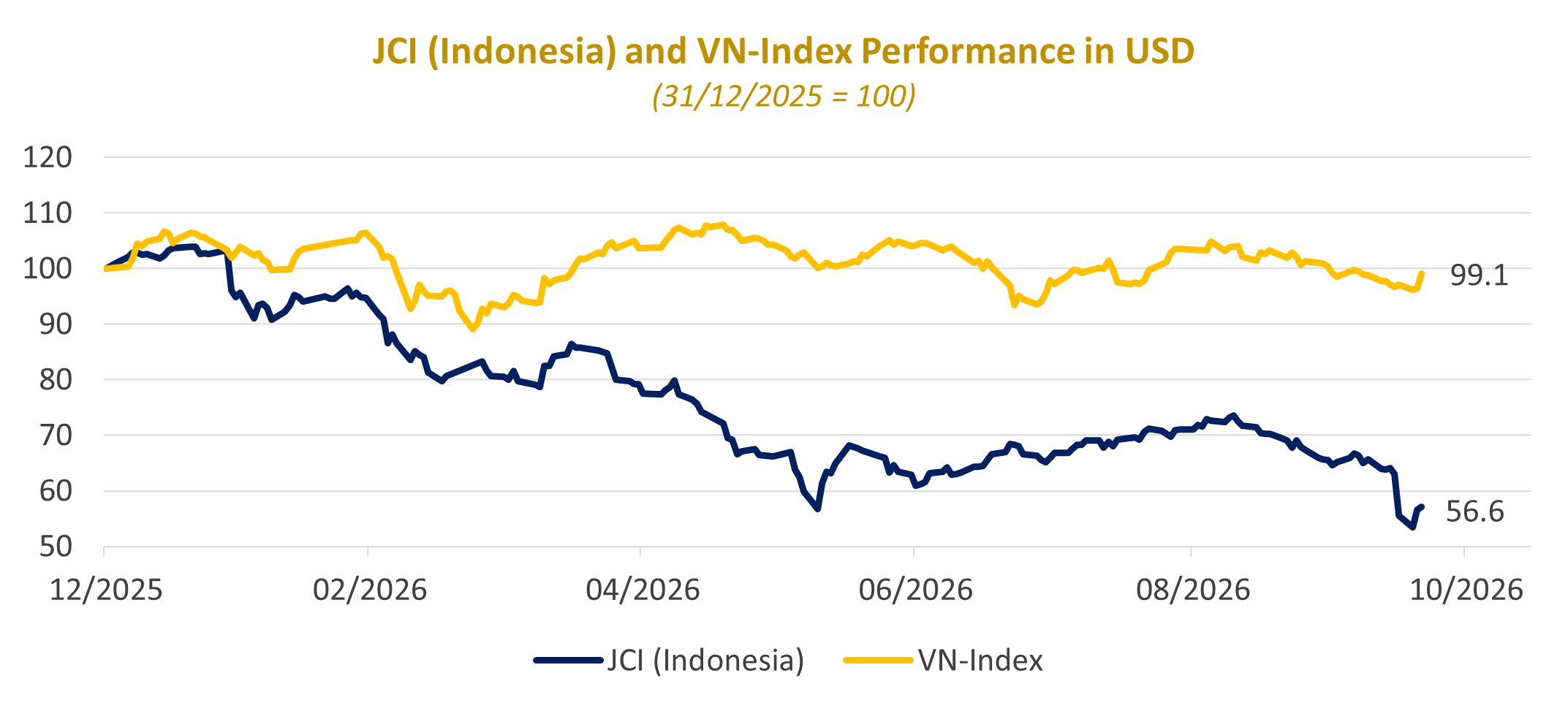
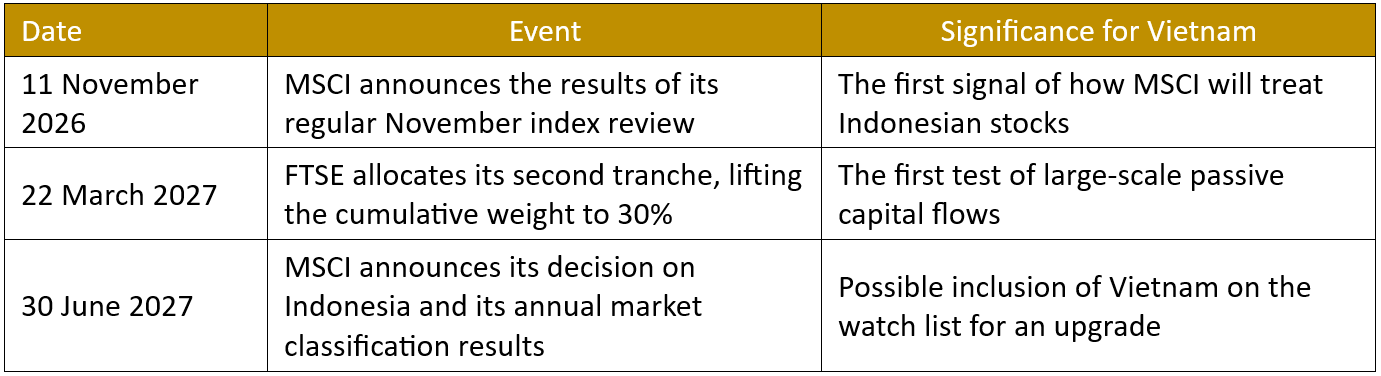
In practice, Indonesia has not yet been downgraded. MSCI will accept comments until April 30, 2027 and will announce its decision by June 30, 2027 at the latest. The institution has made clear, however, that it will proceed with the downgrade unless Indonesia presents clear evidence of improved governance. Argentina is the closest precedent. It was moved directly into the Standalone group in 2021 because of capital controls and has not yet been placed under review for an upgrade, even though it has since loosened foreign exchange controls considerably. The case shows how strictly MSCI judges market classifications.
What MSCI is really concerned about: Who holds the shares and how prices are formed
In its consultation paper, MSCI noted that foreign investors have repeatedly raised concerns about the opaque shareholder structures of Indonesian companies and about coordinated trading that distorts price formation. Passive funds buy shares in proportion to free float. If part of the float counted as tradable is in fact held by a group of related shareholders, index funds must buy a volume that is large relative to the shares genuinely available. Because the available supply is so thin compared with the buying power of the funds, prices can be pushed well above fundamental value. When passive money exits, stocks with thin genuine float fall disproportionately. That links this mechanism directly to the 16 Oct crash. For MSCI, the issue is therefore less about the quality of individual companies and more about whether the market as a whole is investable.
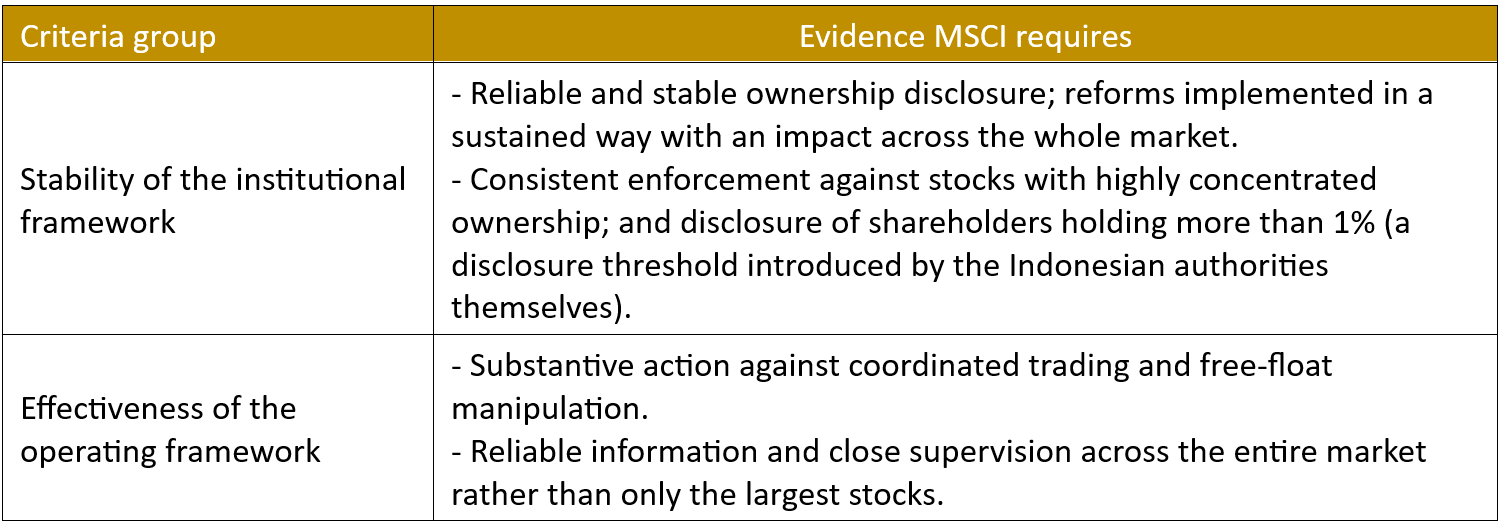
Indonesia has not stood still. After MSCI froze index changes in January, the regulator introduced new rules on the disclosure of major shareholders, began closer monitoring of stocks with concentrated ownership, raised the minimum free-float threshold, imposed heavy penalties in several price manipulation cases, and removed stocks with concentrated ownership from the exchange’s main index. Even so, MSCI does not yet find the progress convincing. What it wants to see is enforcement applied evenly across the whole market and sustained over time, rather than concentrated on the largest names.
Evidence MSCI requires Indonesia to demonstrate
Where Vietnam stands on the same yardstick
Vietnam is still classified by MSCI as a Frontier Market and was not placed on the watch list for an upgrade at the June 2026 review, so the immediate task is to improve its standing against the criteria MSCI uses for upgrades while keeping its standing under FTSE’s standards. Even so, when Vietnam is measured on the same free-float yardstick, the domestic market shows the same weakness as Indonesia. Of the 430 stocks listed on HOSE, 65 have a free float of 15% or less, and among the 40 largest companies these stocks account for 30% of the top-40’s combined market cap.
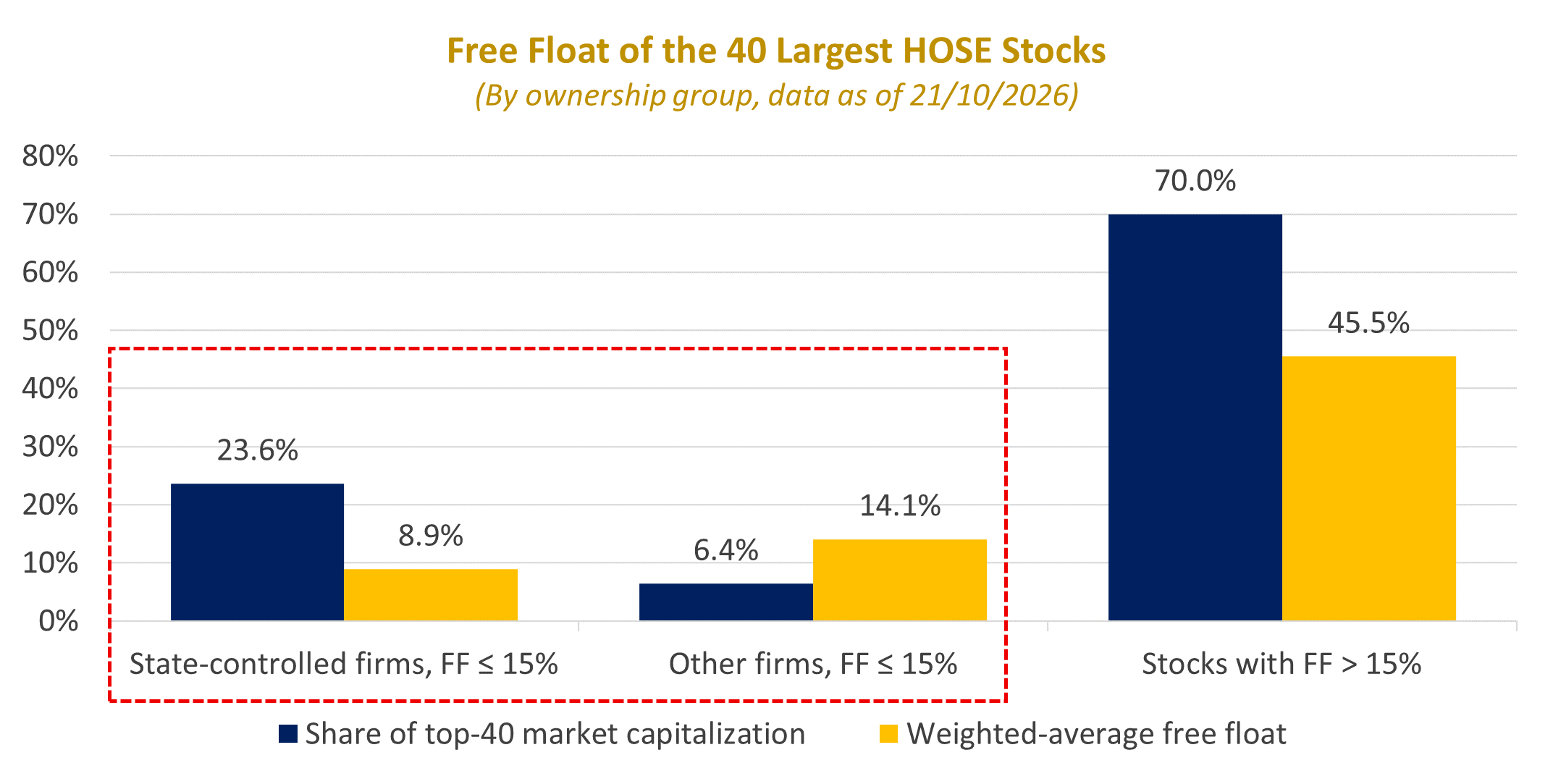
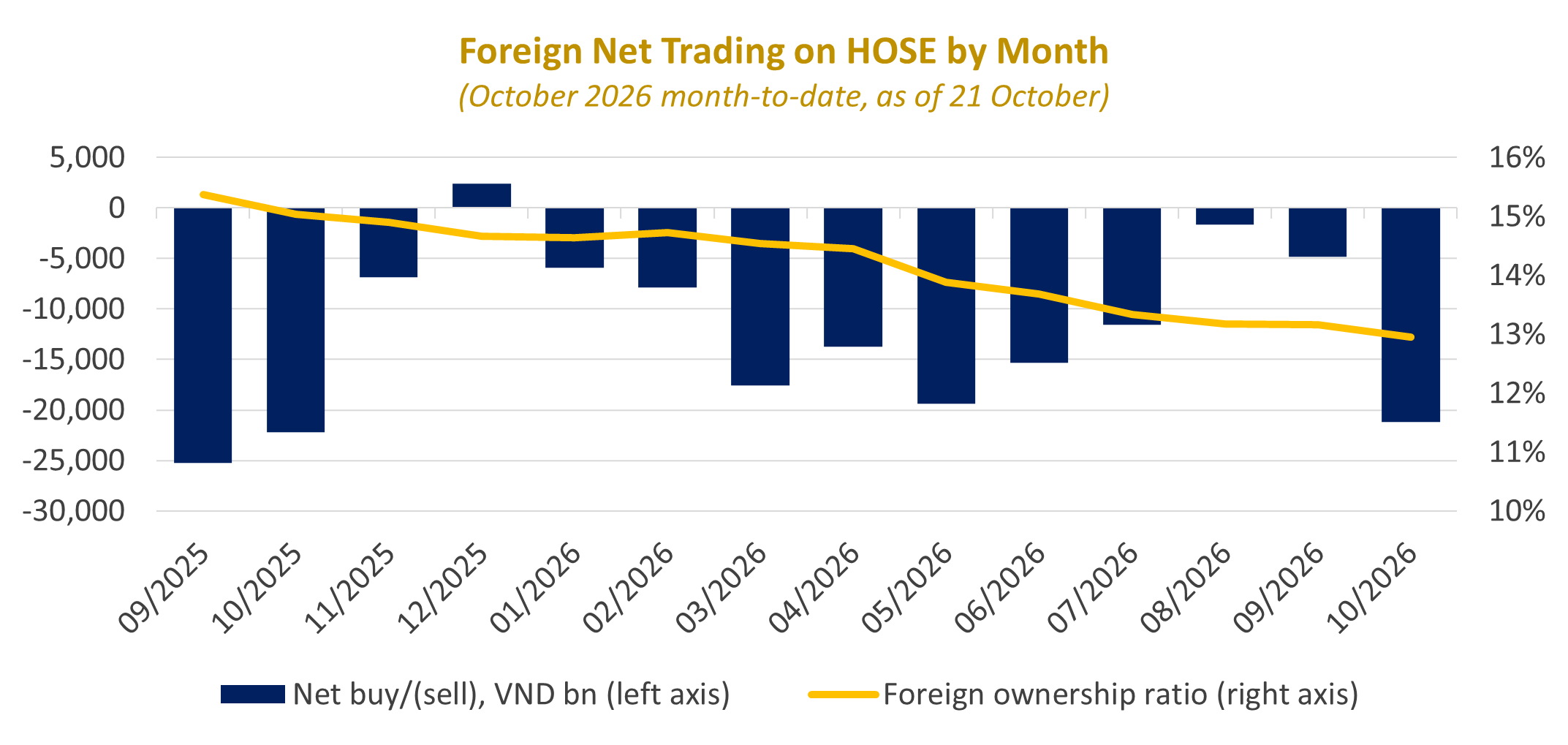
The difference lies in who stands behind the portion of shares that is not free float. Of that 30% of market capitalization, 23.6 percentage points belong to 10 state-owned enterprises in which the state holds at least 50% of capital, with an average free float of only about 8.9%. For Vietnam, the problem in this group is that the tradable portion of the stock is too small. MSCI has placed several large-cap Vietnamese companies with low free float under review. The most significant barrier remains the foreign ownership limit, which currently affects more than 10% of market capitalization.
Hidden ownership: A real risk whose scale is still unmeasured
The risk most similar to Indonesia’s lies in shares that count as free float but are in fact controlled by a single group. In Vietnam, this has already been confirmed through court judgments. In one case, the group led by Mr. Trịnh Văn Quyết used the names of employees and relatives to open roughly 190 accounts and manipulate five stocks: FLC, ART, AMD, HAI and GAB. In another, around 20 accounts registered in the names of nominees were used in the Louis Holdings case, which took TGG from a price of about VND 1,800 to a peak of VND 74,800 in 2021. These cases escaped free-float data because shareholders are only required to disclose when related parties hold 5% or more, and nominees are not classified as related parties. Shares split into small holdings below that threshold therefore continued to appear as if they belonged to retail investors until the regulator stepped in.
The cases handled so far have mainly involved mid-cap and small-cap companies, and no dataset yet measures the scale of hidden ownership across the whole market. That uncertainty is itself a serious question for foreign investors. As passive capital from FTSE allocates by free float, mid-cap stocks whose true free float is thinner than reported are where Indonesia-style risk is most likely to surface.
What Vietnam should prioritize?
Drawing on Indonesia’s experience, Vietnam should give priority to four areas:
1. Ownership transparency: lower the shareholder disclosure threshold from 5% to 1%, as Indonesia has introduced and MSCI now uses to adjust free-float estimates, and publish ownership structures regularly for the whole market in English and in a format that index providers can use directly.
2. Enforcement and early detection: act on nominee accounts and coordinated trading as soon as signs appear, apply clear penalties across all market-capitalization groups, and disclose large negotiated transactions promptly.
3. Foreign room and State divestment: review sectors that still carry foreign ownership caps, operationalize the NVDR framework already provided for in the 2019 Securities Law, drawing on Thailand’s experience, as well as set a credible divestment roadmap for State-owned enterprises with low free float.
4. Central clearing and currency hedging: deploy the central counterparty (CCP) expected in 2027, together with tools that allow foreign investors to separate currency risk from the decision to buy shares.
Key milestones to watch through 2027
Vo Hoang Long- Investment Department, PHFM