THE GOLD PRICE PARADOX AND HOW YOUNG INVESTORS BUILD WEALTH
Global financial flows are entering one of the most complex, volatile and hard-to-predict periods in modern economic history. Recent macro backdrop weaves together persistent inflationary pressure, escalating geopolitical conflicts across the world, and monetary policy changes from the major central banks. Faced with this turbulent picture, traditional asset classes are reacting in ways that fall outside every economics textbook template. Most striking of all is the unexpected weakness of precious metals, gold in particular, at a time when inflation and instability have long been regarded as the strongest catalysts for its rally.
The 2026 context is different: Why does gold price correct sharply in an era of instability?
For decades, financial markets have lived by an unwritten rule that investors repeat to one another: gold is the absolute safe haven whenever the world sinks into inflation or geopolitical risk. Recent market developments, however, have dealt a heavy blow to that prejudice. Even as global inflation remains elevated and the conflict in the Middle East keeps disrupting energy supply chains, the world gold price has gone through deep corrections, at times falling about 31%, from an all-time high of about 5,595 USD/ounce (29 January 2026) to a low of about 3,870 USD/ounce (30 October 2026), even as the world is flooded with news of instability. This stems from the structure of the core macro variables, especially the relationship between gold, real yields and monetary policy.

The real-yield mechanism and the problem of opportunity cost
Unlike financial assets such as stocks, which pay dividends, or bonds, which pay regular interest, gold is by nature a non-yielding asset. The value of this precious metal depends entirely on people’s confidence in its ability to store value and on the difference between buying and selling prices in the market. The biggest barrier to gold’s advance, therefore, is not the stability of the economy but the real yield on risk-free assets. In 2022-2025 this correlation broke down because of heavy reserve buying by central banks. In 2026, once the Fed returned to raising rates (from September 2026) and real yields climbed, this factor took hold of the gold price again, even though central banks kept buying on a net basis.
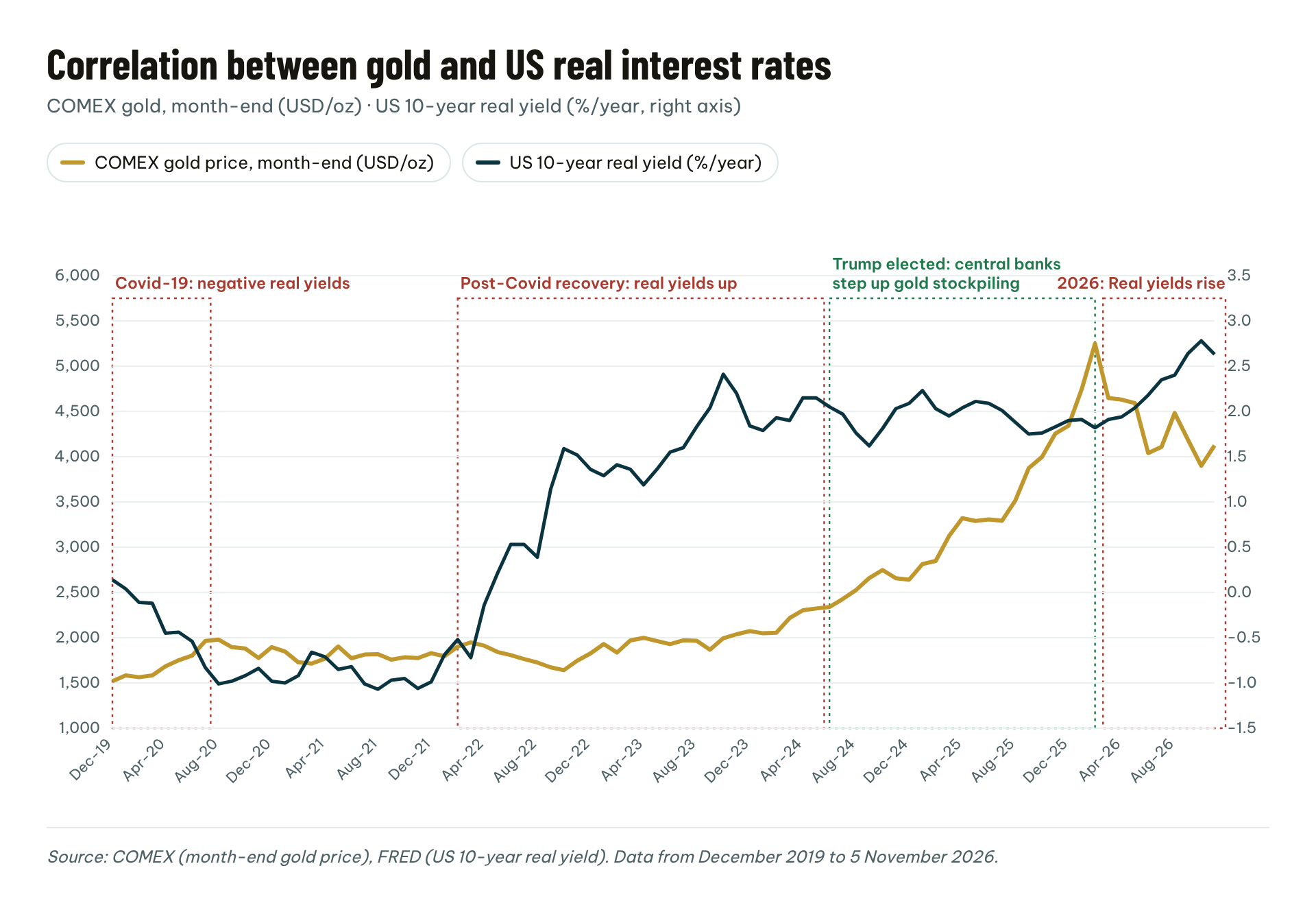
Real yield is a core concept in macro investing, calculated by taking the nominal yield on a government bond and subtracting expected inflation. If a government bond pays 5% interest while inflation is at 6%, the investor is in effect earning a negative real yield and losing purchasing power. In that case, gold becomes extremely attractive because, although it pays no interest, it still preserves core value. Conversely, when central banks firmly maintain a tight monetary policy stance to fight inflation and hold benchmark interest rates at high levels for a long time, the opportunity cost of holding gold becomes more expensive.
The Fed’s actions have pushed US Treasury yields, especially those on Treasury Inflation-Protected Securities (TIPS), up to record highs. When an institutional investor can earn a positive and completely safe real yield from holding US government bonds, the opportunity cost of keeping a non-yielding metal such as gold becomes far too expensive. The resilience of the US economy, with Q3 2026 GDP growth of 3.4% annualized (BEA advance estimate, released 29 October 2026) and core personal consumption expenditures (PCE) inflation not easing as fast as expected, has led the market to believe that high interest rates will last longer. In that case, part of the money rotates into assets that deliver real cash flow, creating downward pressure on this precious metal.
Cross-liquidity pressure and the rotation of financial assets
Another aspect that explains gold price’s movement amid the turmoil is its role as a liquidity buffer for financial institutions. When macro risks reach their peak, global stock markets frequently face severe sell-offs. For example, when US technology stocks fall sharply on concerns about the profitability of enormous investments in artificial intelligence, selling pressure spreads immediately.
When risky portfolios plunge and investors face margin-call thresholds, financial instruments are often triggered to rebalance portfolios. Investment funds and individual investors are forced to sell the most liquid, easiest-to-sell assets in the portfolio, those that have fallen the least, to quickly raise cash and cover their positions. Gold then becomes a victim of its own safety and excellent liquidity. Investors sell gold not because its core outlook has worsened, but because it is the most readily available tool for generating cash to balance leveraged positions that are under threat in the stock market.
The combination of a strong US dollar, high real interest rates, and the pressure of profit-taking liquidations after an overheated rally has created an enormous burden, pushing the gold price down again and again even as geopolitical hot spots remain ablaze. During past periods of financial market turbulence, gold has often outperformed other assets initially, only to decline alongside the broader market later as correlations between assets increased.
The “non-yielding asset” philosophy through Warren Buffett’s lens:
Warren Buffett, who has always prized the durability of cash flow, in his 2011 letter to Berkshire Hathaway shareholders divided the entire world of assets into three main groups: currencies, non-yielding assets (gold being the typical example), and value-creating assets (productive businesses, farms, commercial real estate). By this thought, gold belongs to the second group. A bar of gold, however carefully polished and stored, remains forever a silent piece of metal. It does not produce wheat like a farm, does not generate dividends like a company, and does not contribute to the real economy’s production chain.
Buying gold is expecting that in the future, fear of inflation or of the collapse of some currency will push someone else to pay a higher price for that same glittering metal. A great companion of Buffett’s, Charlie Munger, also remarked that it is strange for investors to rush to buy a metal that only truly rises in price if the world edges toward the brink of collapse.
When inflation occurs but the market believes central banks will be able to contain inflation with high interest rates, that fear subsides, and gold’s appealing veneer gradually fades. Gold should therefore be seen in its proper place: as a hedge that comes at a cost, suited to a moderate weighting in a portfolio, and not an engine for growing wealth within a portfolio aimed at prosperity.
The generational gap in thinking about sustainable accumulation
The journey of building financial prosperity for today’s young generation differs in many ways from that of the previous generation.
For the generation born and raised during the subsidy era or the early days of the reform period, the nation’s macro financial picture was still quite limited. They lived through periods of very high inflation in the 1980s and 1990s, in which the value of money eroded quickly. At that time the stock market had not yet formed, the banking system was not as developed as it is today, and the very concept of investment funds was still in the very early stage. With so few tools to protect assets, people commonly relied on tangible things: gold and land. Scraping together every bit of salary to buy a piece of gold, then carefully tucking it away at the bottom of a cabinet, was both a way of saving and a sensible way of preserving asset value in those circumstances.
The success of the gold-hoarding approach in the past may have created a cognitive bias: many parents still regard gold as a safe investment that preserves value against inflation shocks.
Young people today: A surge in cash flow and digital leverage
Unlike the previous generation, today’s young workforce, people aged 22 to 38, faces far harsher modern economic challenges. The cost of living, healthcare and education inflation, and above all property prices have moved far beyond the reach of average incomes. A young person earning 15 to 30 million VND a month can almost never dream of buying a home in the big cities in the short term. As a result, accumulating gold gradually no longer appeals to young people.
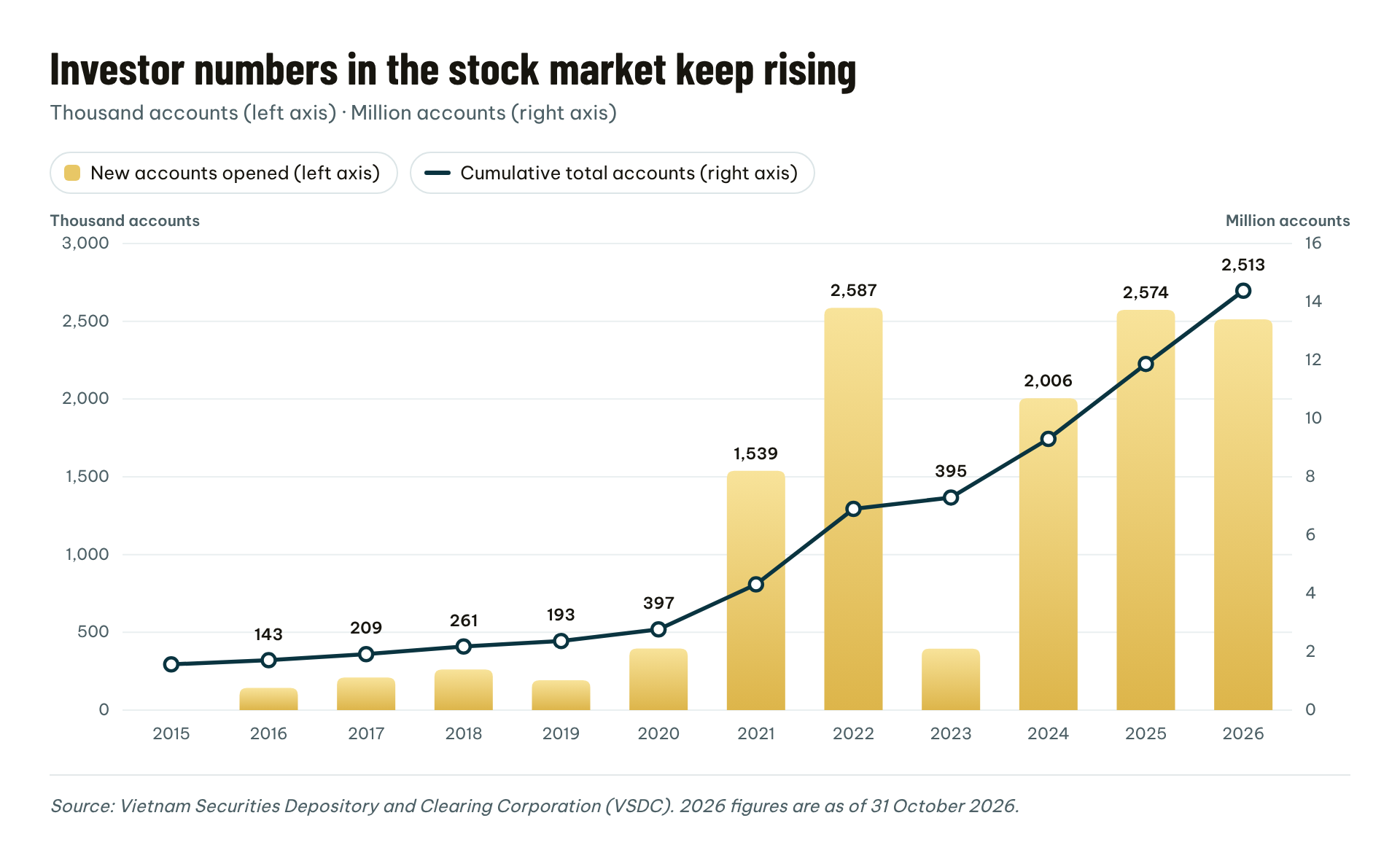
This young generation’s advantage lies in its access to information, its sharpness, its steadily rising financial literacy, and the powerful boom of the digital technology era. This shift is reflected directly in how young people build and manage their assets. Young people today deeply understand the power of compound interest and clearly recognize that, to escape the income trap, their assets must be tireless money-printing machines rather than lying idle in a safe like a lump of metal. The emergence of technology platforms for digital wealth management and of advanced securities brokerage apps is gradually changing investment habits in Vietnam.
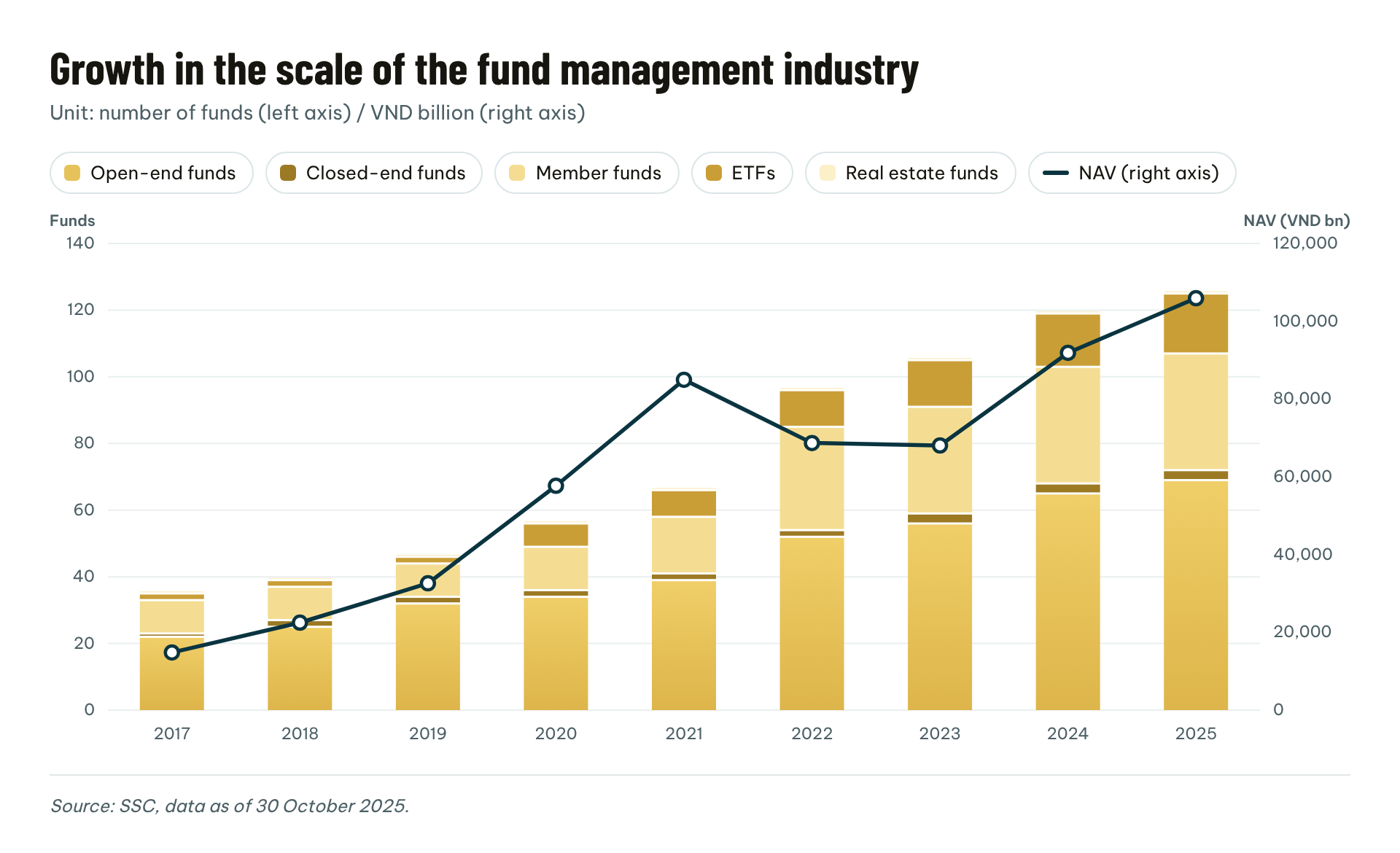
Gold for protection, cash-flow assets for growth
Vietnam’s fund management industry has grown strongly in the number of funds and in net asset value over 2017-2025, despite some years of correction such as 2022-2023. More and more investors, especially young people, are choosing to accumulate through investment funds rather than holding individual assets themselves.
None of this means gold has lost its role. Gold remains a hedge against sudden shocks, but a hedge that comes at a cost: it generates no cash flow, comes under pressure when real yields rise, and, when traded in Vietnam, the buyer must also account for the gap between the buying and selling price. Gold therefore suits the role of a “cushion” at a moderate weighting, not the main engine for growing assets.
Long-term wealth growth comes from assets that generate cash flow: profitable businesses that share profits with shareholders and are held long enough for compounding to work. For young people with a stable income, investing regularly through funds is a disciplined and diversified way to gain exposure to these assets, without having to pick individual stocks.
Vo Hoang Long- Investment Department, PHFM