

INTEREST RATES AND THE MONETARY STORY: THE END OF THE GLOBAL CHEAP-MONEY CYCLE
What is happening in global markets?
The global monetary environment is undergoing a restructuring of interest-rate levels on a scale that have not seen in the past three decades. In the U.S., the 10-year Treasury yield has reached 5.24%, along with the 30-year yield to 5.56%, its highest level since 2004.
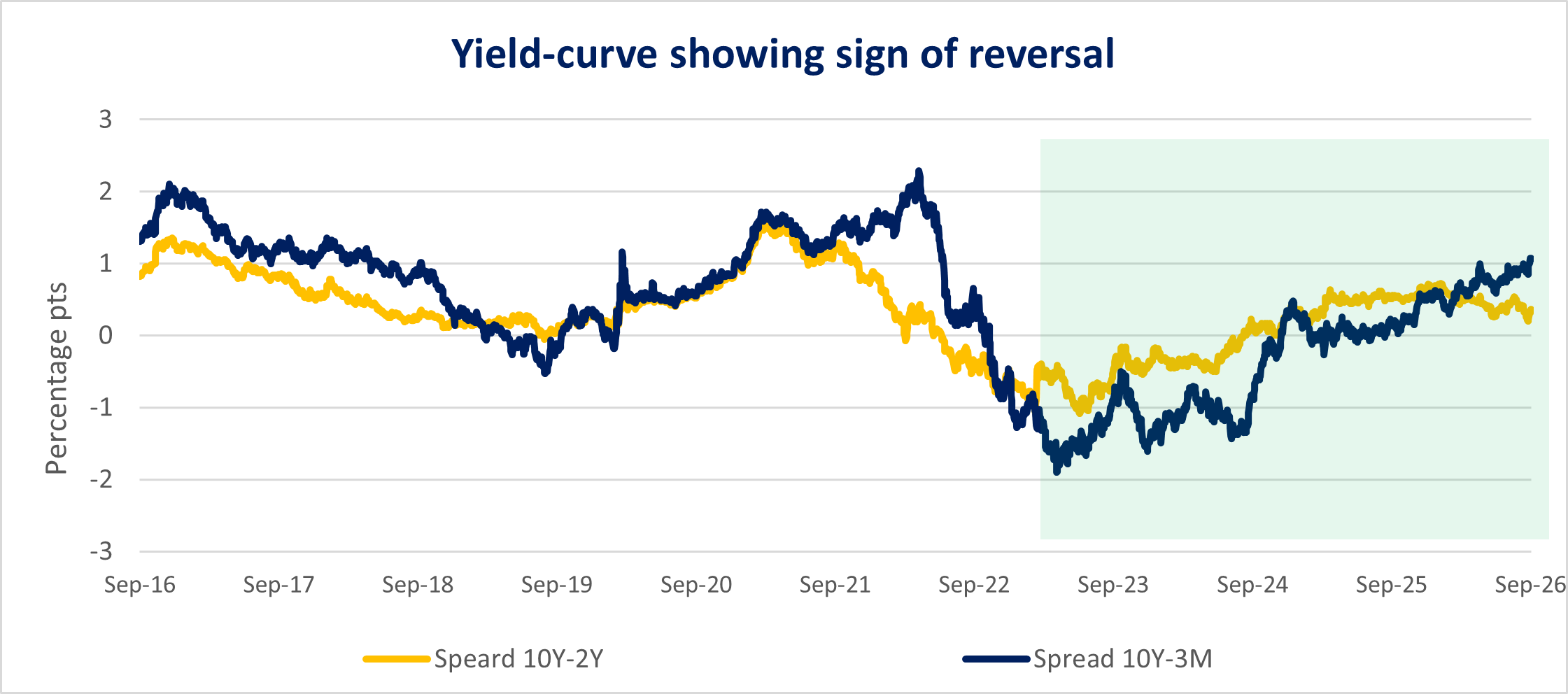
Notably, the yield curve has been re-steepening after a prolonged period of deep inversion, with the spread between 10-year and 2-year yields now returning to positive territory. Unlike previous cycles, when the yield curve steepened primarily because short-term yields fell sharply as the U.S. Federal Reserve eased monetary policy, the current steepening is being driven by a sharp rise in long-term yields. This reflects a change in investor expectations, as investors now demand substantially higher compensation for the risks associated with holding long-duration bonds.
Beyond the United States, other major economies are also moving toward a higher cost-of-capital environment. The European Central Bank (ECB) has taken a hawkish turn by raising its key policy rates, bringing the marginal lending facility rate to 2.90% and the deposit facility rate to 2.50% in response to persistent inflationary pressures, largely stemming from energy-price shocks related to geopolitical tensions in the Middle East.
In Asia, the Bank of Japan (BOJ) has also raised its policy rate to 1.25%, bringing Japan’s cost of capital to its highest level since April 1995. The move is intended not only to contain inflation but also to support the yen amid significant depreciation. The BOJ’s exit from its low-interest-rate policy has closed the major tool as source of cheap funding that investors had used for decades to finance investments in risk assets around the world.
Is this time really different?
In previous monetary tightening cycles, increases in nominal yields were primarily driven by rising inflation expectations. However, the latest move in yields above 5% reflects a fundamentally different mechanism. By decomposing the 10-year Treasury yield into two separate components: the breakeven inflation rate and the real yield, we can identify the underlying change in the new cost-of-capital environment.
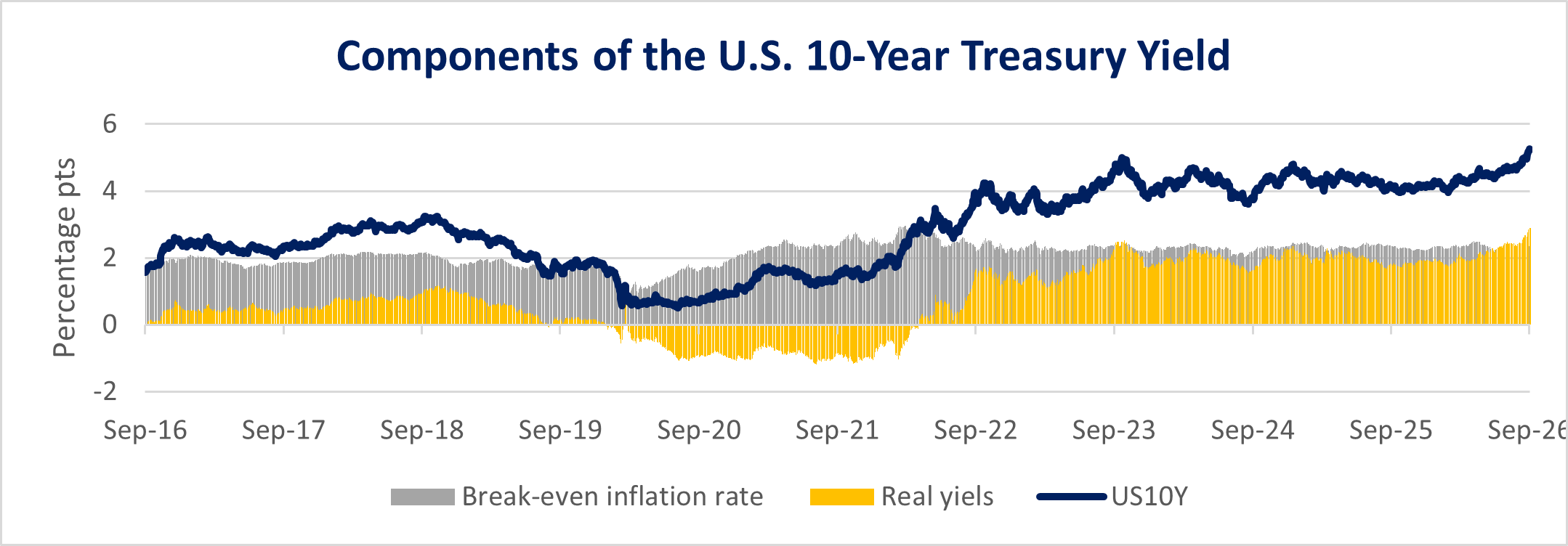
Since the Covid-19 pandemic, the 10-year breakeven inflation rate has generally remained around 2.34%. This stability indicates that the market continues to have confidence in the Fed’s ability to control inflation over the long term. Therefore, inflation is not the main factor driving the nominal 10-year yield toward 5%. Instead, the primary driver has been the sharp rise in expected real yields. The real yield has increased to 2.90%, compared with negative or near-zero levels throughout much of the previous decade. This indicates that global investors now require a substantially higher real rate of return before they are willing to lend over long maturities.
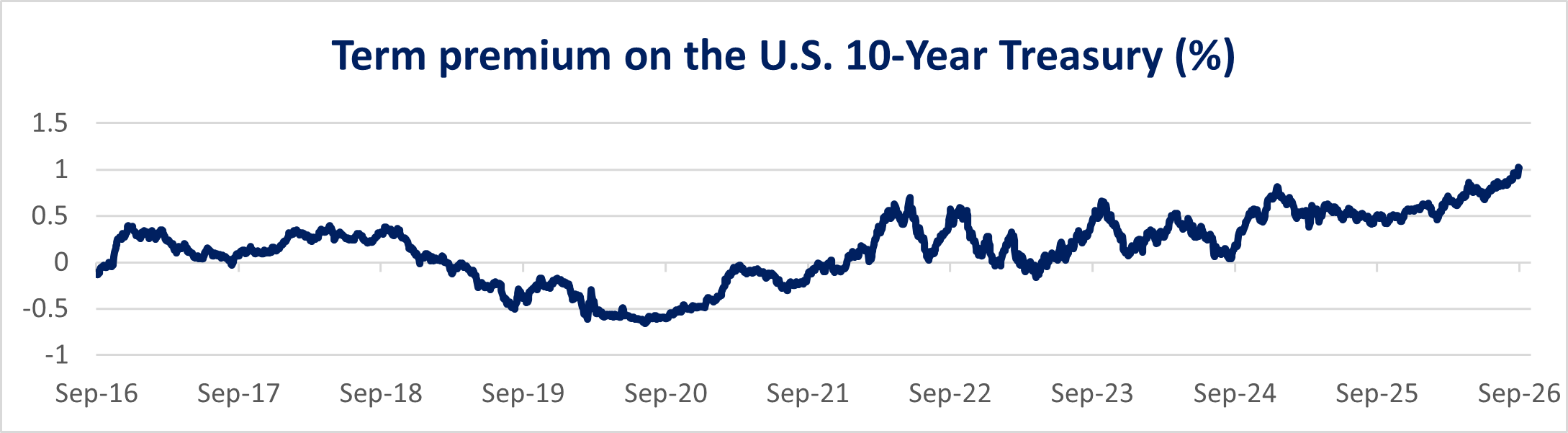
The underlying reason for the increase in real yields is the expansion of the term premium on U.S. government bonds. According to the ACM model developed by the Federal Reserve Bank of New York, the 10-year term premium is currently estimated at 1.02%. This represents the additional return investors require to compensate for the risk of holding long-term bonds rather than continuously rolling over short-term instruments. The reversal in the term premium reflects growing concerns about the supply-demand balance in government debt markets and broader macroeconomic uncertainty.
The forces shaping an era of higher interest rates
The higher-interest-rate environment facing global markets is not merely a temporary phenomenon. It is the result of several long-term structural forces.
Expansionary fiscal policy and growing debt-supply pressure
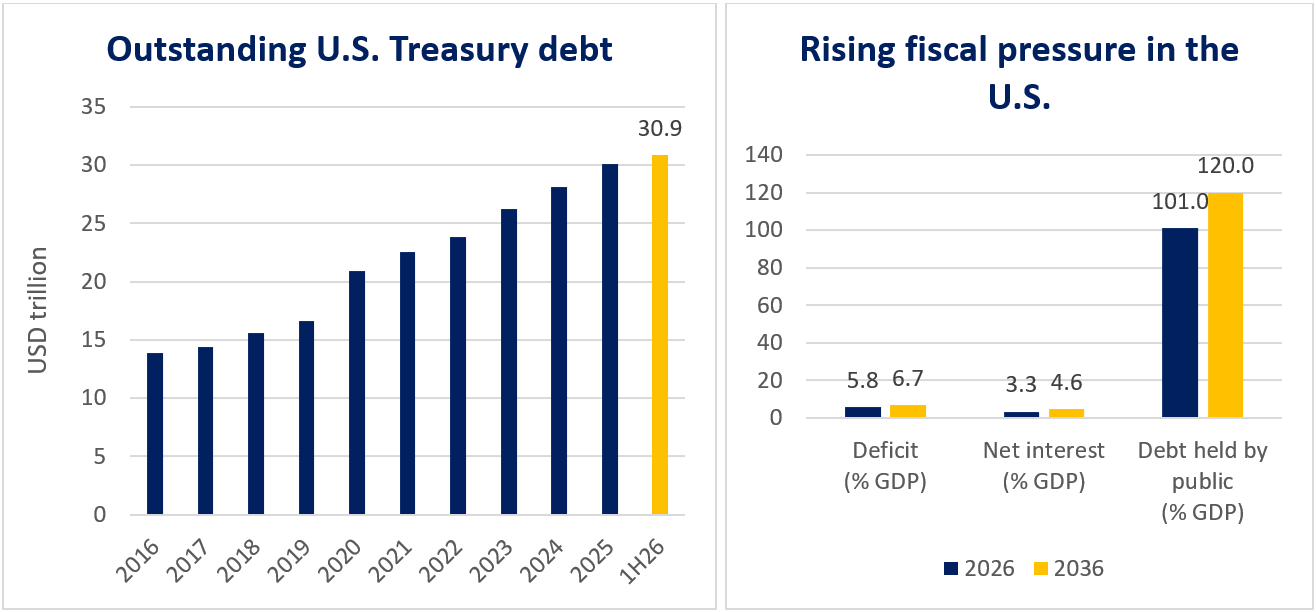
The most direct factor pushing the term premium higher is the severe fiscal imbalance of the U.S. government. According to projections from the U.S. Congressional Budget Office (CBO), the budget deficit is expected to reach USD1.9 trillion in 2026, equivalent to 5.8% of GDP. More importantly, debt held by the public is projected to rise from 101% of GDP in 2026 to a record 120% of GDP by 2036. At the same time that U.S. Treasury issuance is increasing sharply while the composition of Treasury buyers is becoming less supportive. During the era of monetary easing, central banks purchased bonds with relatively little sensitivity to price. Today, as the Fed conducts quantitative tightening and trade-surplus countries reduce their accumulation of U.S. dollars to limit foreign-exchange risk, more of the burden of absorbing government debt is shifting toward private investors. These investors are only willing to purchase the debt when yields rise sufficiently to compensate for long-term inflation and credit risks.
Artificial Intelligence and the massive capital-expenditure cycle
Source: SEC, U.S Census Bureau, BEA, companies’ report
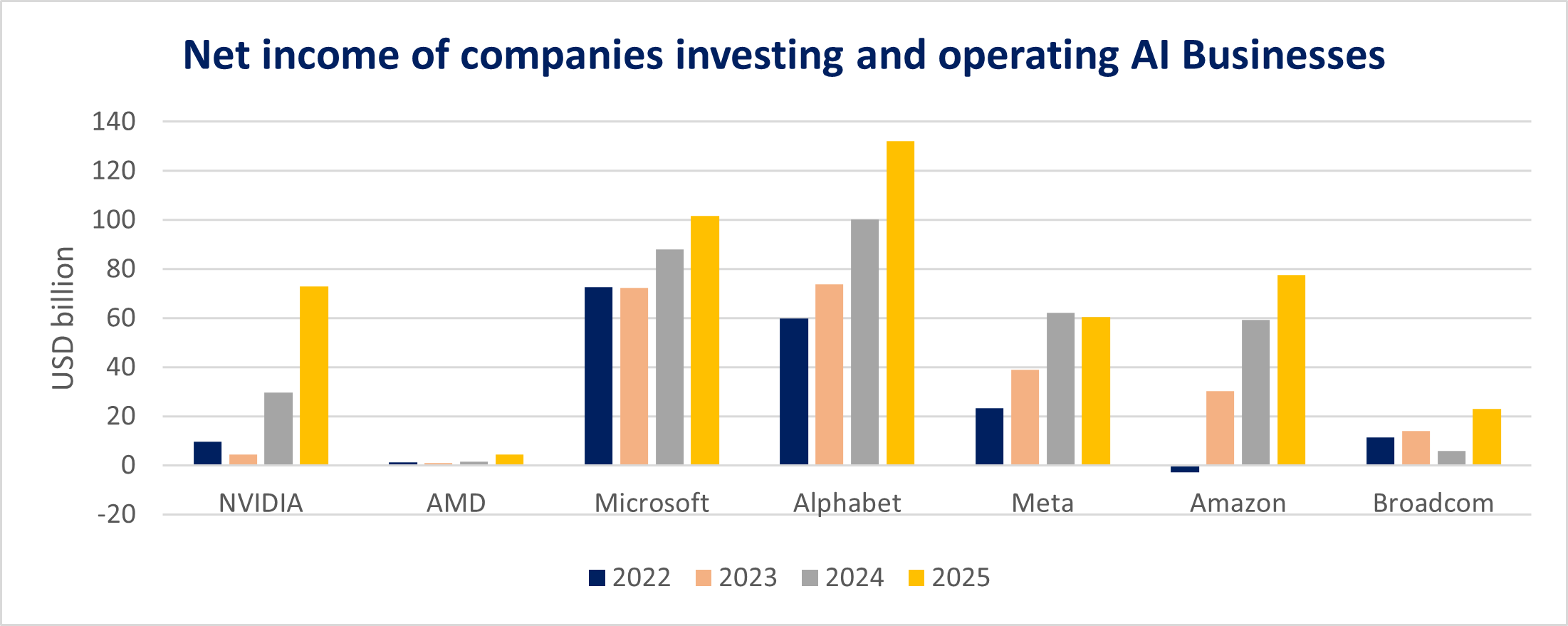
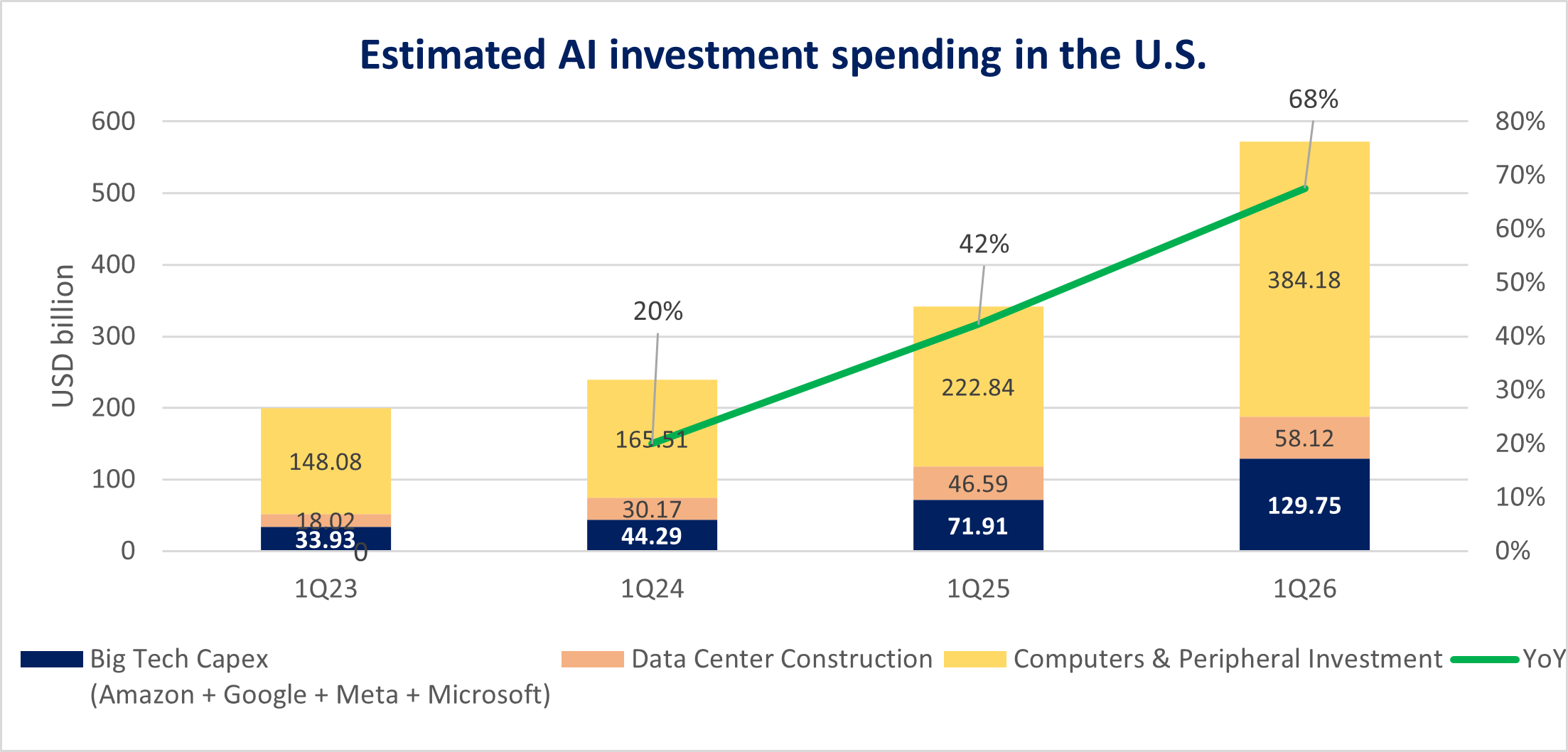
Contrary to traditional economic models, in which interest rates above 5% would typically increase the risk of recession, the U.S. economy continues to demonstrate remarkable resilience. The primary driver is the artificial intelligence boom, which has triggered a large-scale capital-expenditure cycle. Technology and industrial companies are investing trillions of U.S. dollars in data-center infrastructure, energy, and semiconductors. AI-driven automation and productivity improvements allow these companies to maintain or even expand profit margins despite higher borrowing costs. As a result, although capital demand is rising sharply, companies remain willing to borrow and invest even when interest rates are already high. This, in turn, raises the natural equilibrium interest rate and keeps the overall U.S. interest-rate environment elevated. When the expected return on investment (ROI) from large-scale technology projects significantly exceeds a 5% cost of capital, the economy can continue to absorb capital aggressively, reducing the effectiveness of central-bank tightening.
The shift in global investment flows
The Bank of Japan’s decision to raise interest rates to 1.25% and gradually normalize monetary policy is reshaping one of the most important capital flows in the global bond market.
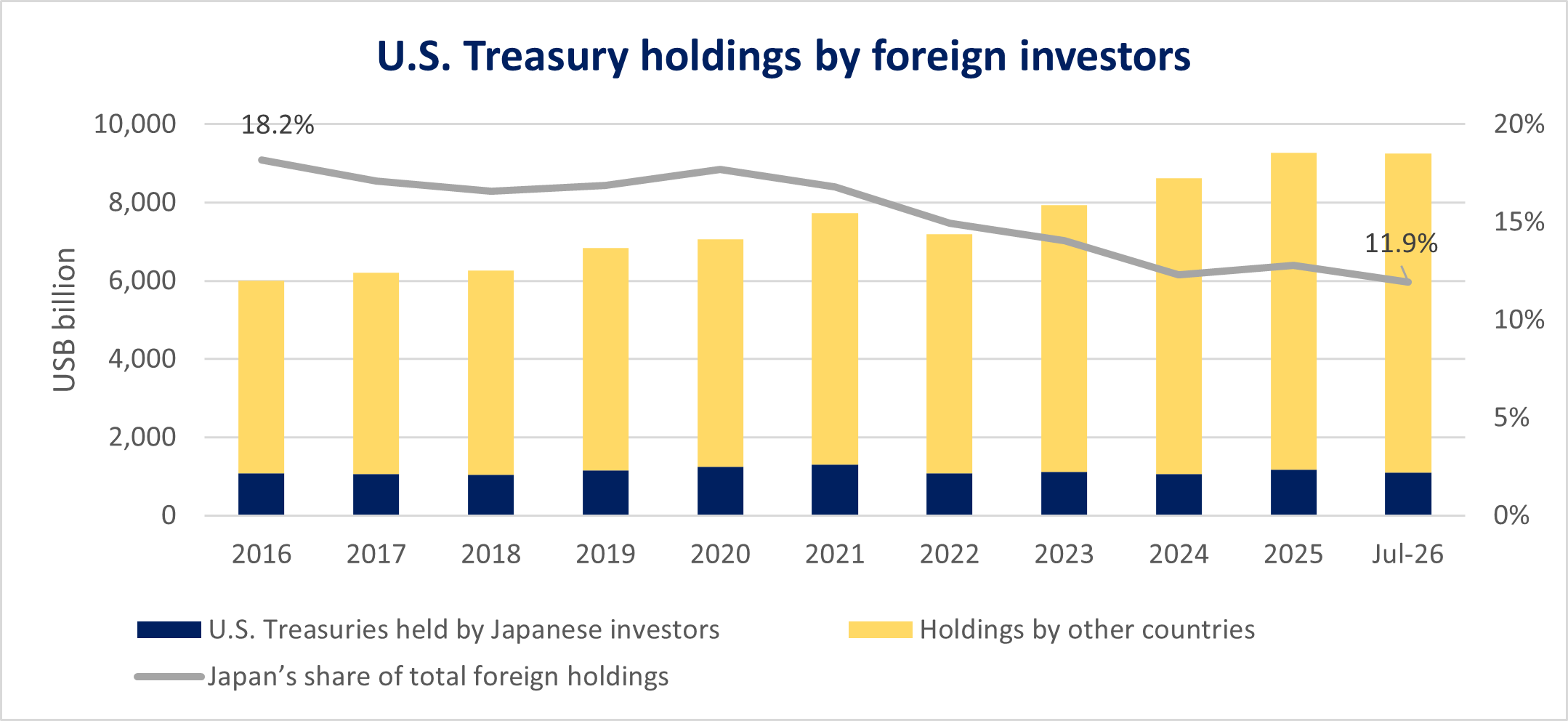
For decades, cheap funding from Japan served as one of the key sources of liquidity supporting U.S. and European bond markets. As domestic Japanese yields become more attractive, the incentive for Japanese financial institutions to continue allocating capital abroad has weakened. In practice, Japan has not engaged in a broad-based sell-off of U.S. Treasuries and remains the largest foreign creditor to the United States. However, Japanese holdings have remained broadly flat while total U.S. Treasuries held by foreign investors have continued to increase. As a result, Japan’s share of total foreign Treasury holdings has declined from 18.2% in 2016 to 11.9% in 2026. In other words, rather than withdrawing capital aggressively, Japanese investors are playing a smaller role in absorbing new Treasury supply by reducing incremental purchases or not fully reinvesting proceeds when bonds mature. As U.S. assets become relatively less attractive because of changes in opportunity costs, the market must rebalance by pushing the term premium higher in order to retain international investors and attract new capital.
Investment implication
Global signals suggest that the high-interest-rate environment is likely to persist for an extended period. At the same time, tighter monetary policies across major central banks will continue to reshape the global cost of capital. As expensive capital becomes the new normal, investment strategies are likely to shift from asking “Who can grow the fastest?” toward asking “Who can generate cash flow without relying on cheap funding?”
About businesses:
Companies with an advantage: These are companies with low debt levels or substantial net cash positions, high returns on invested capital (ROIC), and consistent operating cash flows. During the cheap-money era, extensive use of financial leverage allowed many companies to achieve rapid growth. However, when capital becomes expensive, a healthy balance sheet becomes a genuine competitive advantage, allowing companies to finance expansion internally and gain market share.
Companies under pressure: These include highly leveraged business models, companies that require continuous capital raising to expand, and startup or technology companies whose expected profits lie far in the future. As discount rates used in valuation models increase, the present value of these future earnings can decline significantly.
About asset allocation:
From a portfolio-construction perspective, fixed-income investments, including bank deposits and bond funds, are now offering meaningful returns. They should no longer be viewed merely as temporary places to hold cash while waiting for investment opportunities as before. Instead, fixed income should be considered an active asset-allocation component in current portfolios.
For equity investments, both the benchmark for risk and the required return premium have changed. Any expected return from equities should now be evaluated carefully against the 12-month deposit rate, which is currently holding at around 7-8%. Only investments that provide a sufficiently attractive risk premium above this interest-rate benchmark are likely to generate genuinely effective long-term returns.
Vo Hoang Long- Investment Department, PHFM